The useful question is not which financial system is better. It is whether the customers a business wants to serve use mobile money differently from traditional bank channels.
The headline gap
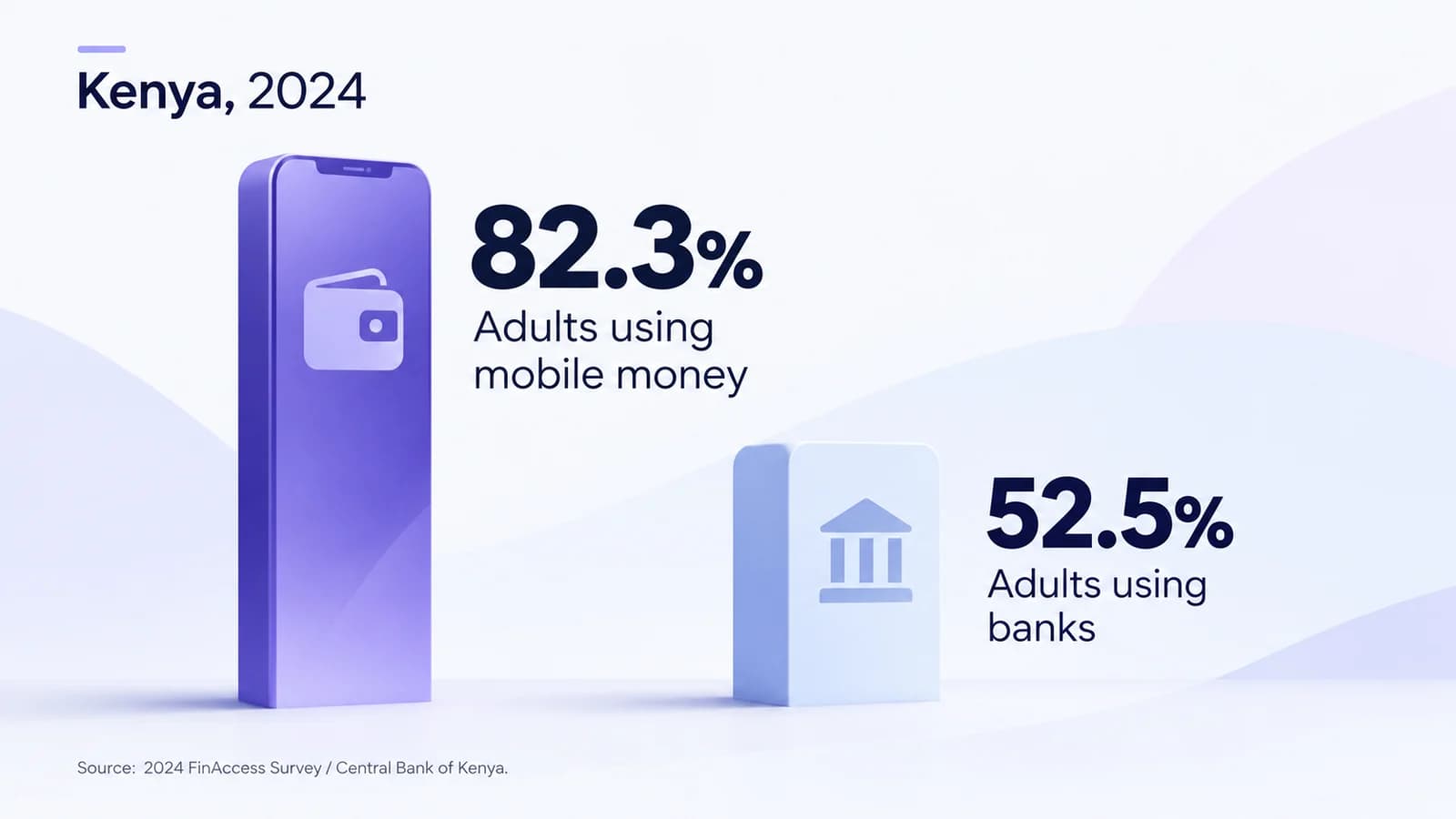
The 2024 FinAccess Household Survey found materially higher adult usage of mobile money than banks in Kenya. The full figures and definitions are maintained in our Kenya mobile-money statistics guide rather than repeated here.
Why the gap matters for recurring businesses
A card- or bank-first business can have a strong product and still create payment friction if a meaningful part of its audience prefers a local wallet for everyday payments.
For a local business, the opposite can be true: mobile-money acceptance is already solved, while billing, recovery and reconciliation remain manual.
Do not convert the usage gap into a product claim
Higher mobile-money usage does not prove that every customer will prefer a wallet, that cards are unnecessary or that recurring-payment software will improve conversion.
Use the national data to justify testing. Use merchant data to make the decision.
What to measure
- payment-method selection;
- first-attempt completion;
- time to pay;
- support contacts;
- recovery by payment method.
The gap matters differently by business model
A local gym that already receives nearly every payment through M-PESA may learn nothing new from adding another checkout logo. Its opportunity is operational: matching, recovery and reconciliation.
A foreign SaaS company may face the opposite problem. Its billing operations may already be mature, but local-wallet access can be the missing piece for customers who do not want to use the existing card flow.
Segment your own customer data
National usage statistics are a starting point. The merchant should compare payment-method preference by customer segment, acquisition channel, plan size and country. That is what reveals whether mobile money is an access problem, an operations problem or both.
Use the gap to form a testable question
Instead of saying “Kenyans use mobile money more than banks, therefore we need wallet billing,” ask: “If we offer an approved local-wallet route to this customer segment, does completion improve without increasing support or reconciliation cost?”
That turns national statistics into a product experiment rather than a marketing conclusion.