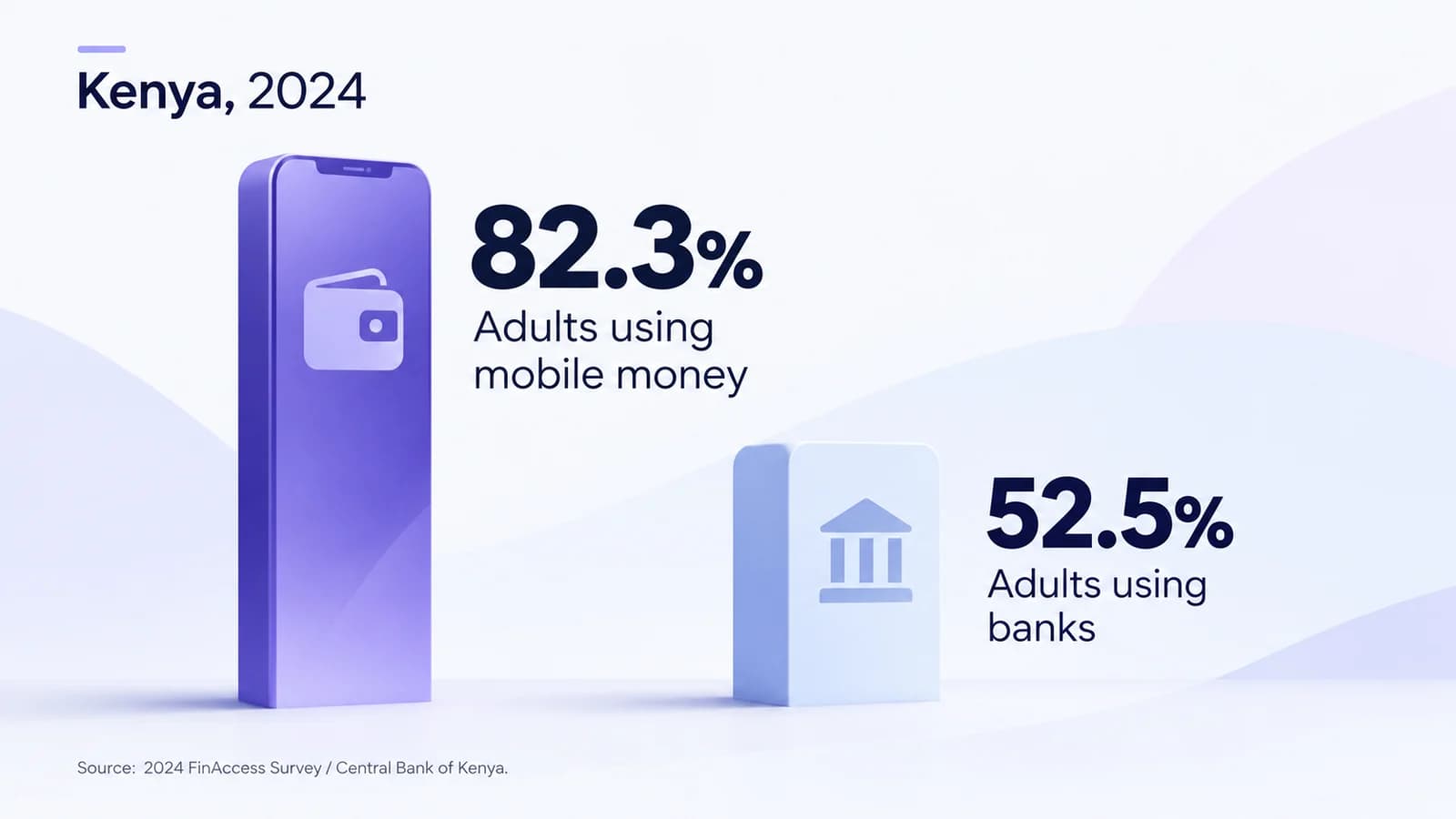
A useful FinAccess finding is not just that Kenyans use mobile money. It is that mobile money has become a major method for paying recurring household expenses.
The figure
A Central Bank of Kenya report drawing on FinAccess survey results states that in 2024, 68.0% of respondents used mobile money for monthly expenses such as rent, utilities and school fees, while 31.7% used cash.
The same report notes that in 2021 the split was close to even: 49.0% mobile money and 49.2% cash.
What it tells businesses
Mobile money is already part of repeated household payment behaviour. A recurring-revenue business does not need to teach the market that wallets can be used more than once.
The product question is whether the business can turn that familiar payment behaviour into a cleaner due-date, status, recovery and reconciliation workflow.
What it does not tell businesses
The 68% figure does not mean 68% of every merchant's customers want automated recurring debit, nor does it identify one wallet or provider.
It describes payment behaviour at the household level. Merchant-specific payment preferences still need to be measured.
Repeated household use is different from automated debit
The monthly-expense figure shows that people repeatedly use mobile money for categories such as rent, utilities and school fees. It does not say those payments happen automatically or under a standing instruction.
That distinction matters for product design. A business can build a recurring billing experience around a familiar payment method while still requiring customer authorization when the chosen rail requires it.
The operational opportunity sits around the payment
If customers are already comfortable paying a repeated expense through mobile money, the merchant can focus on making the surrounding workflow better: clear due-date context, the right account reference, accurate payment status, safe recovery and immediate reminder suppression after payment.
Use category behavior carefully
Rent, utilities and school fees do not behave identically. The due-date policy, partial-payment rules and service consequences differ. A recurring platform should therefore reuse the billing primitives without forcing one recovery policy across every expense category.
Source
Central Bank of Kenya, Banking Sub-Sector Report — Lessons from FinAccess Surveys: https://www.centralbank.go.ke/wp-content/uploads/2025/11/Banking-Sub-Sector-Report-Lessons-from-FinAccess-Surveys-November-2025.pdf