Kenya has several "mobile money" numbers, and they measure different things
Research mobile money in Kenya and you will find figures above 90 million, figures around 54 million and adult usage rates in the low 80s. All of them can be correct, because they measure different things. For market sizing, investor materials and product decisions, the difference matters. This guide separates four views: mobile-money subscriptions, registered mobile-money accounts, adult usage and merchant-payment activity.
Kenya mobile-money snapshot
The latest figures, as of 8 October 2026:
| Metric | Latest figure | What it measures |
|---|---|---|
| Mobile-money subscriptions | 54.01 million (June 2026) | Telecom-linked subscriptions reported by the Communications Authority |
| Registered mobile-money accounts | 95.31 million (August 2026) | Total registered accounts reported by the Central Bank of Kenya |
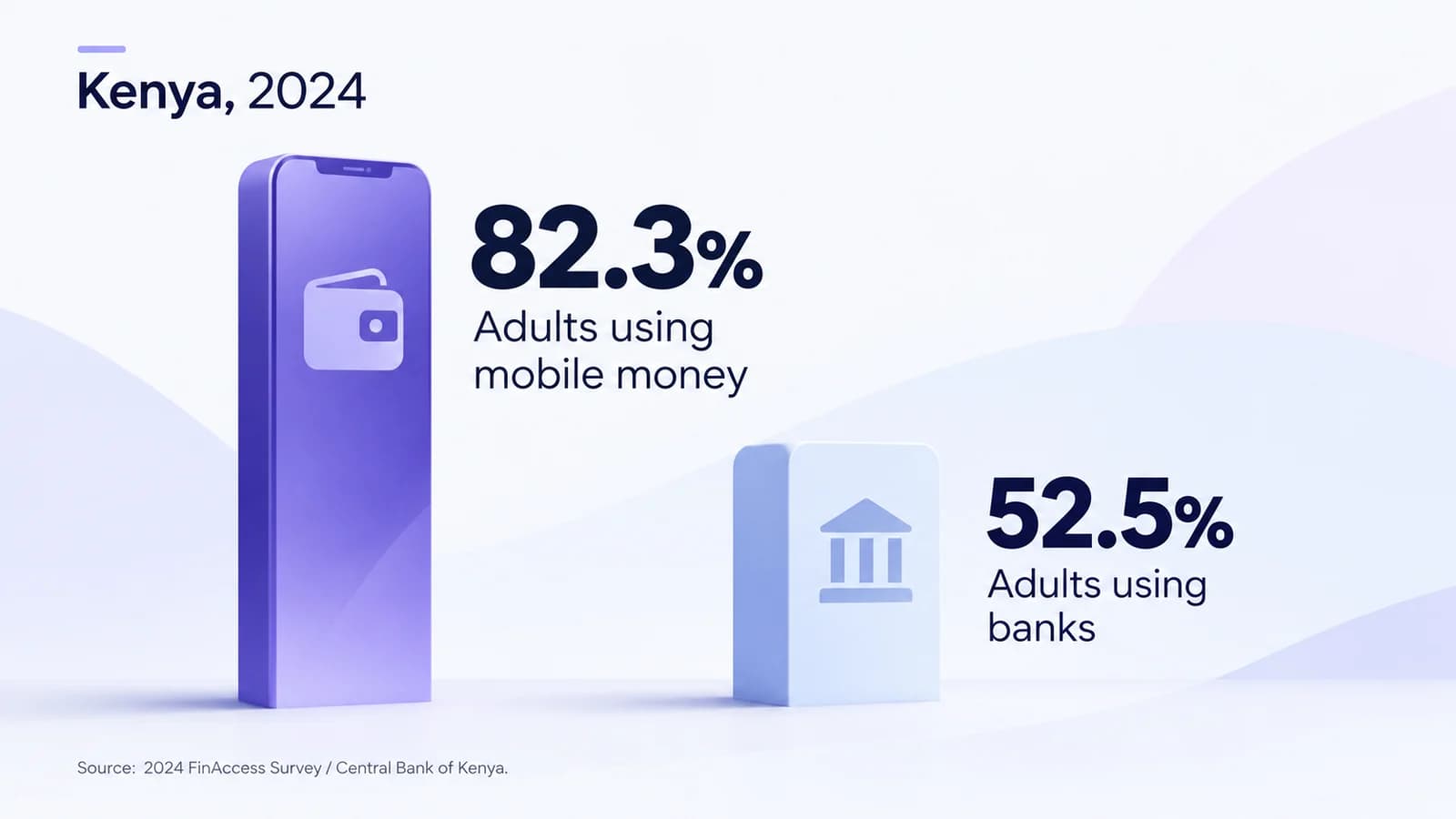
| Adults using mobile money | 82.3% (2024) | People-based usage from the FinAccess Household Survey |
| Adults using banks | 52.5% (2024) | People-based bank usage from FinAccess |
| Global mobile-money merchant payments | USD 155 billion (2025) | Merchant-payment value reported by GSMA |
| Merchant-payment growth | +42% (2025 vs 2024) | GSMA estimate |
| East Africa's share of that growth | About three-quarters | GSMA 2026 report |
Mobile-money subscriptions: 54.01 million in June 2026
The Communications Authority of Kenya reported 54,005,800 active mobile-money subscriptions for the quarter ending June 2026, up from 53,368,939 in March 2026. Safaricom's M-PESA held 88.8% of subscriptions and Airtel Money 11.1%. This is the figure to use when discussing telecom-linked mobile-money subscriptions. It is not "54.01 million unique Kenyans": one person can hold more than one SIM or wallet, so it is a count of subscriptions, not people.
Registered mobile-money accounts: 95.31 million in August 2026
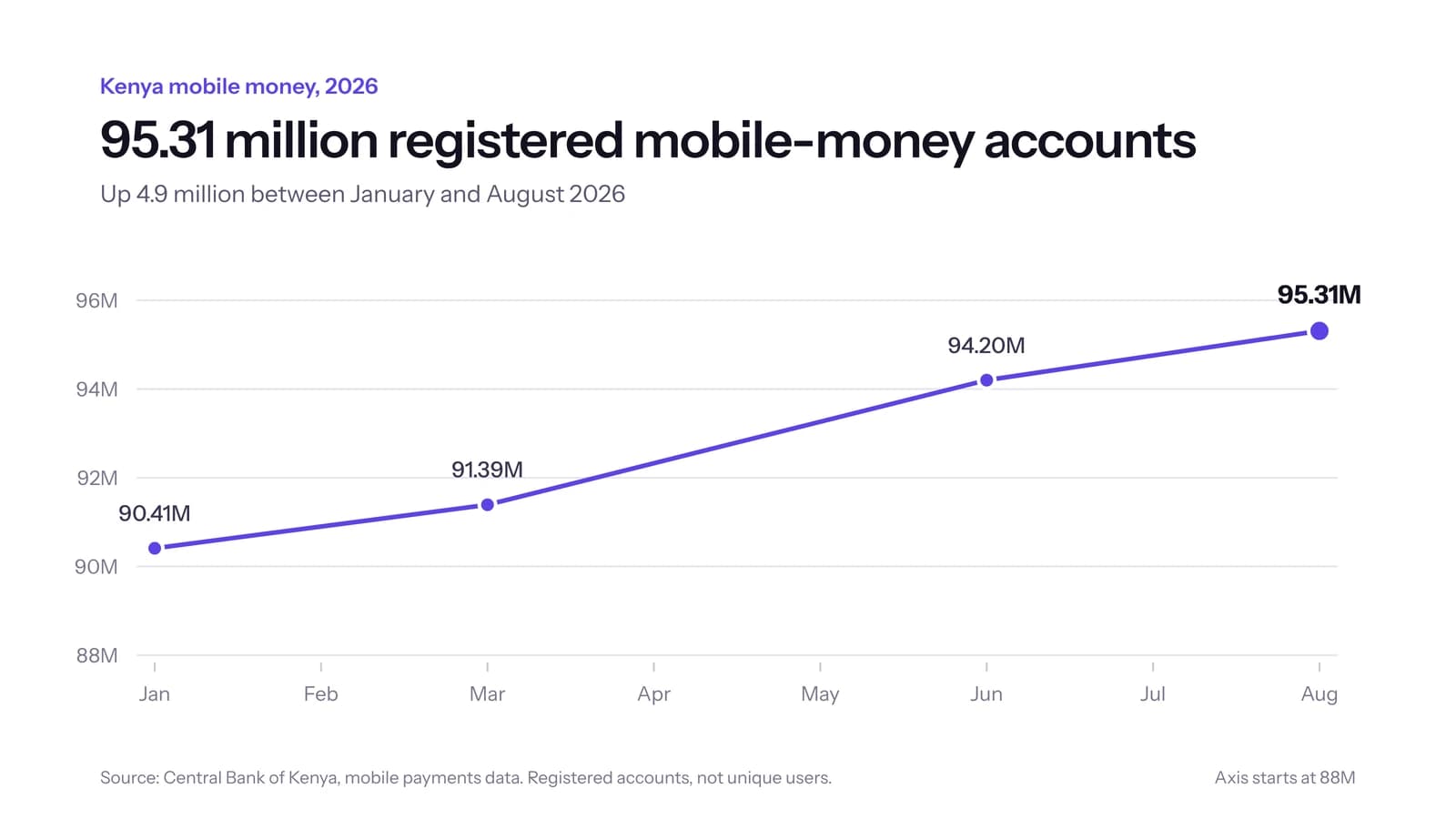
The Central Bank of Kenya publishes a separate series. For August 2026 it reported 95.31 million registered mobile-money accounts. That is far higher than the CA figure because it measures something different. Do not write "95 million Kenyans use mobile money": a person can have several accounts, and a registered account is not necessarily active.
The registered-account base kept growing through 2026:
| Month (2026) | Registered accounts |
|---|---|
| January | 90.41 million |
| March | 91.39 million |
| June | 94.20 million |
| August | 95.31 million |
Adult usage: 82.3% in the 2024 FinAccess Household Survey
The 2024 FinAccess Household Survey gives a people-based view: 82.3% of Kenyan adults used mobile money, compared with 52.5% who used banks. That answers the question "How common is mobile money in Kenyan adults' financial lives?" FinAccess also reported that daily mobile-money use had risen to 52.6%. Availability and frequent use are different things, and for a recurring-revenue business frequency matters: a payment method people use every day is more relevant to renewal design than a headline account count.
Why the three Kenyan measures should not be merged
These statements are not interchangeable:
- "Kenya has 54.01 million mobile-money subscriptions" is a subscription count.
- "Kenya has 95.31 million registered mobile-money accounts" is an account count.
- "82.3% of Kenyan adults use mobile money" is a people-based usage estimate.
A credible article, deck or market model keeps those definitions intact. This matters most in market sizing: treating 95.31 million accounts as 95.31 million unique customers would badly overstate the addressable population.
Merchant payments are the more relevant signal for businesses
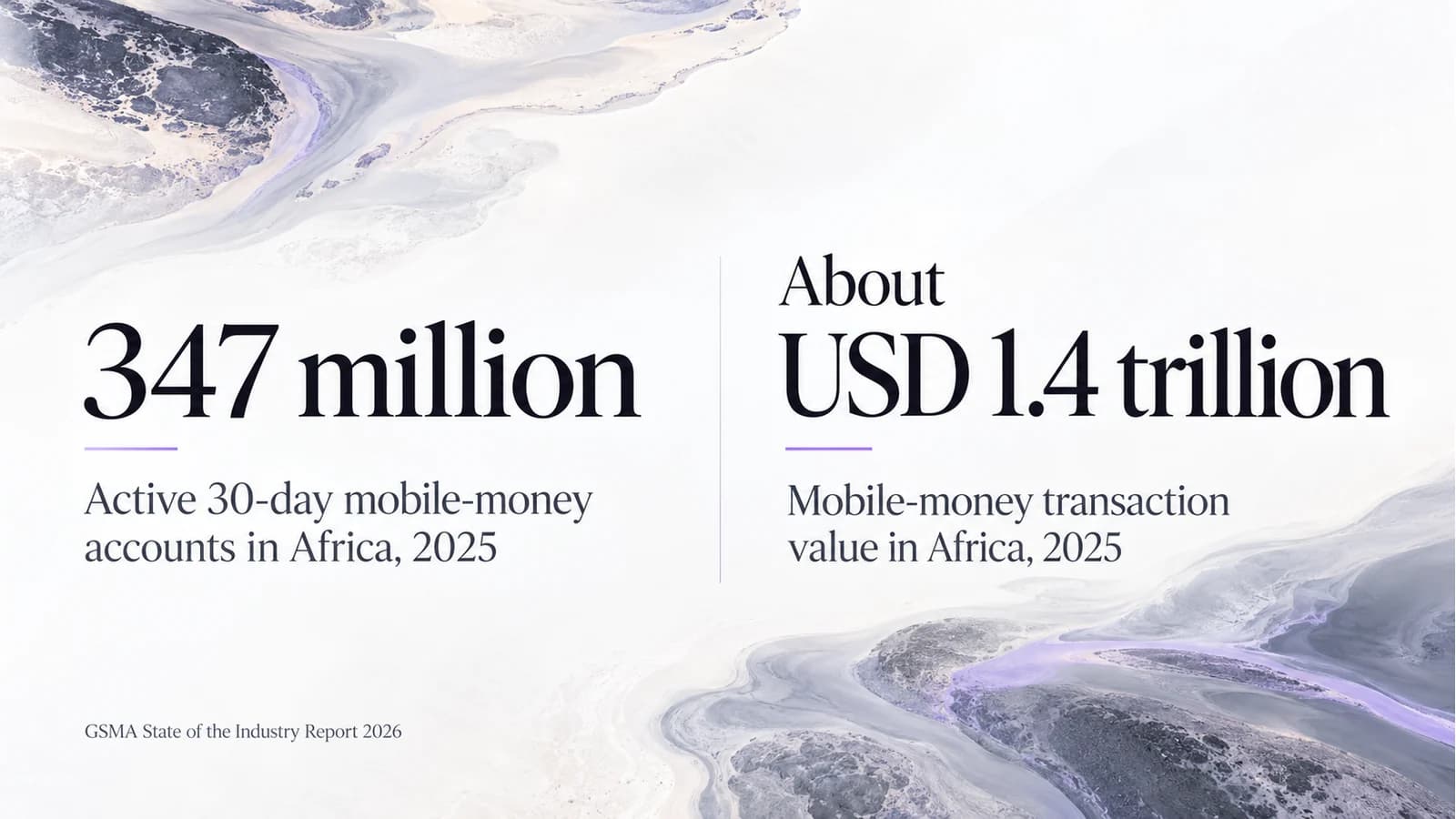
Mobile money is no longer mainly a person-to-person transfer system. GSMA's 2026 State of the Industry Report estimated global mobile-money merchant payments at USD 155 billion in 2025, 42% higher than in 2024, and found that East Africa accounted for roughly three-quarters of that growth. Merchant payments are closer to the commercial use case than total mobile-money transaction value. The figure does not mean USD 155 billion is the market for recurring-payment software; it shows that mobile money is increasingly used to pay businesses.
What the data means for a Kenyan recurring business
Mobile money deserves a deliberate decision
A business serving Kenyan consumers should make a conscious choice about mobile money rather than treating it as a minor payment method. That does not mean every customer prefers M-PESA or Airtel Money; it means the payment strategy should be informed by the market.
Payment access and billing operations are separate questions
A local wallet can make paying easier, but the business still has to manage what is due, payment status, recovery, matching and reconciliation. High mobile-money usage does not make those recurring operations automatic.
Card-first businesses should test local payment access
A SaaS company entering Kenya may already have excellent subscription billing. The question is whether adding M-PESA or another local method improves payment completion, activation, renewal, support load and reach. Measure that with your own data rather than inferring it from national adoption figures.
Local businesses may have the opposite problem
A Kenyan gym, school or membership organisation may already collect almost entirely through M-PESA. Its problem is not payment access; it is knowing who is due, matching references, stopping reminders, handling unresolved payments and reconciling finance records. The same statistics support two very different business problems. Our guide to recurring payments in Kenya covers both.
What these figures do not prove
The data does not prove that:
- every Kenyan business needs recurring-payment software;
- every mobile-money user is a potential subscription customer;
- every wallet supports the same recurring-payment mechanics;
- every merchant can be approved by every PSP;
- mobile money will outperform cards for every customer segment;
- any specific recovery or conversion rate is achievable.
National statistics describe the payment environment. Whether a product fits a market still has to be shown merchant by merchant.
How to cite these numbers
- For a pitch deck: "Kenya had 54.01 million mobile-money subscriptions by June 2026, according to the Communications Authority."
- For a market overview: "CBK reported 95.31 million registered mobile-money accounts in August 2026."
- For consumer usage: "The 2024 FinAccess Household Survey found that 82.3% of Kenyan adults used mobile money, compared with 52.5% using banks."
- For merchant-payment context: "GSMA estimated global mobile-money merchant payments at USD 155 billion in 2025, up 42% year on year, with East Africa accounting for roughly three-quarters of the growth."
Keep each figure attached to its definition.