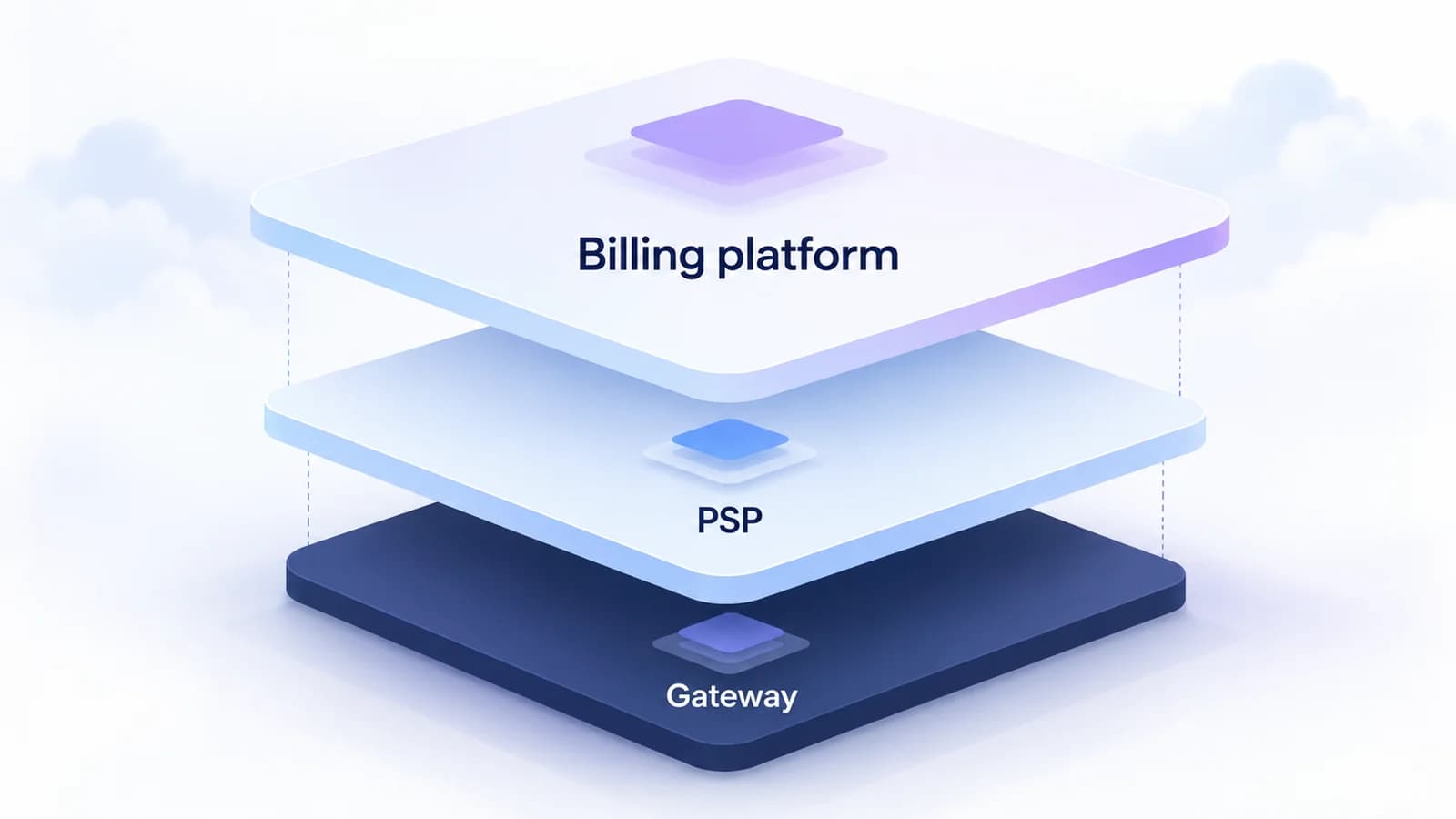
A recurring-revenue business needs more than a way to move money. It needs several layers that answer different questions.
1. Commercial rule
What does the customer owe, how often, and under what plan or agreement?
2. Invoice or obligation
What is due for this specific period?
3. Payment route
Which approved method can the customer use in this country: mobile money, card, bank or another rail?
4. Payment state
Did the attempt succeed, fail, expire or remain unresolved?
5. Recovery
What should happen when the invoice remains unpaid?
6. Service state
Does non-payment change access, membership or account status?
7. Reconciliation
Can finance prove which provider transaction settled which invoice and trace downstream settlement evidence?
Keeping the layers separate lets a merchant change payment provider or add a new market without rebuilding the commercial relationship from scratch.
Why the layers should remain separate
When one system tries to make the payment provider, invoice, service state and finance ledger all the same object, every provider change becomes risky. Separating the layers gives each part one job and makes the interfaces between them explicit.
A simple example
A gym in Nairobi can define a monthly membership rule, create a November invoice, let the member pay through M-PESA, move the membership into Paid when the transaction is verified and reconcile the provider reference later. If the gym later adds Airtel Money, the membership rule and invoice do not need to change.
What changes during regional expansion
The payment route, currency, provider account and settlement process may change by country. The recurring rule, invoice, recovery framework and service-state contract can remain stable.
What this infrastructure is not
- It is not a claim that one company should hold or settle every payment.
- It is not a replacement for licensed PSPs and operators.
- It is not a guarantee that every wallet supports the same authorization method.
It is an operating model for connecting commercial recurrence to whichever approved payment rails the merchant can use.