Behind the Numbers is our series that takes official payment and telecoms reports and explains what they mean in plain language, for business owners and anyone whose money moves through a phone.
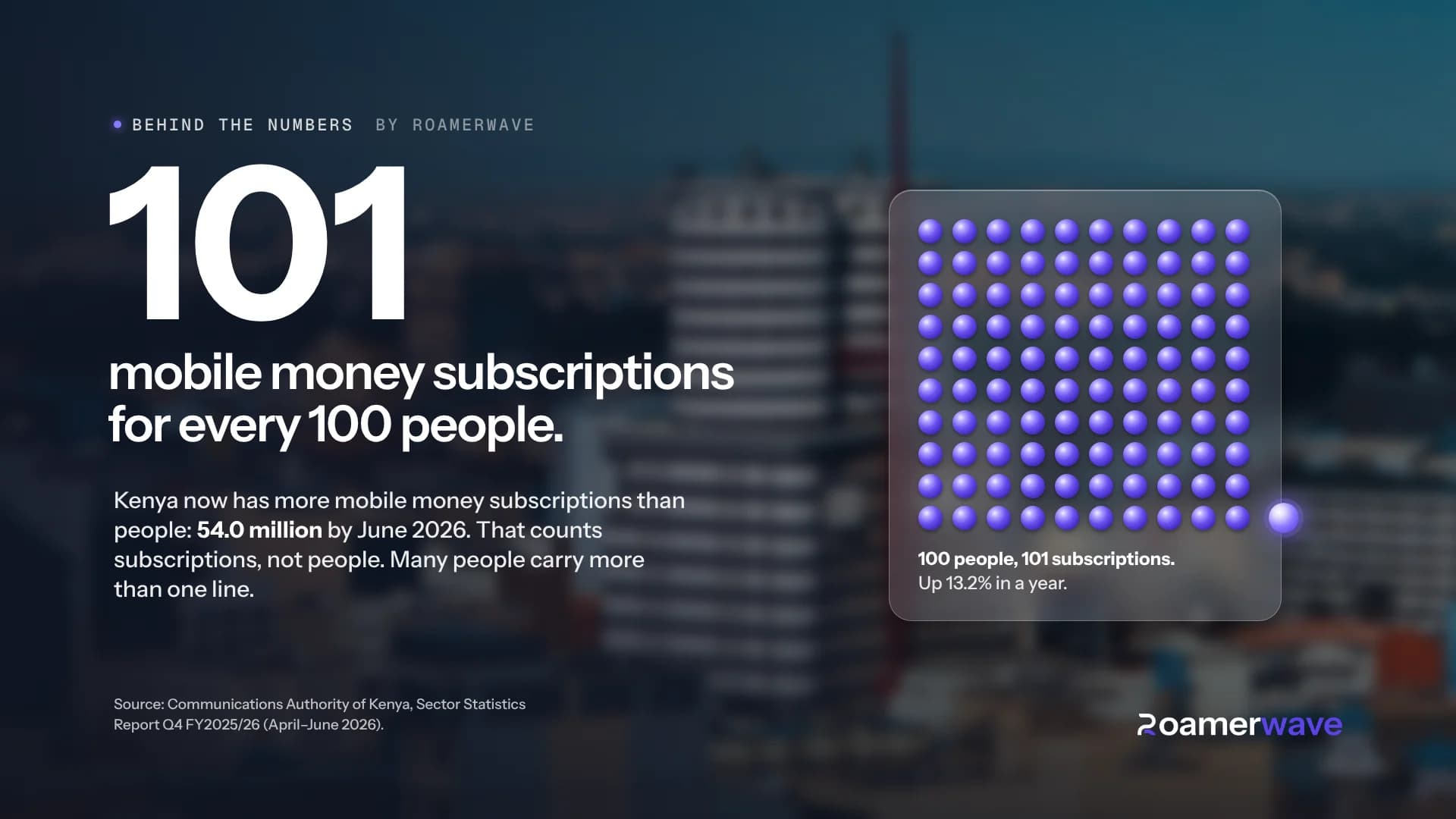
The Communications Authority of Kenya (CA) has published its figures for April to June 2026. The headline is easy to repeat: 54.0 million mobile money subscriptions, or 101.3 for every 100 people in the country. The more useful point sits underneath it. Paying by phone is no longer the hard part for Kenyan customers. For any business that collects money from the same customers every month, the work has moved to what happens after the money is sent: knowing who paid, through which channel, for what, and when.
Here are five things the latest numbers say, and what each one means in practice.
1. “More subscriptions than people” does not mean more users than people
By 30 June 2026, Kenya had 54,005,800 mobile money subscriptions. That is 636,861 more than at the end of March, and 13.2% more than a year earlier. The CA divides subscriptions by the population to get a “penetration rate”, and that rate is now above 100%: 101.3%, up from 100.1% in March.
A penetration rate above 100% does not mean every Kenyan, including newborns, has a wallet. It counts subscriptions, not people. Many adults have two SIM cards, and some use more than one mobile money service. So the figure is best read as a measure of how deeply mobile money is built into daily life, not as a headcount.
What it means for a business: one customer can reach you from more than one number or wallet. A school parent might pay from her own line in January and her husband’s in February. If your records assume one customer equals one phone number, some payments will look like they came from a stranger.
2. Two official counts, two different numbers, both correct
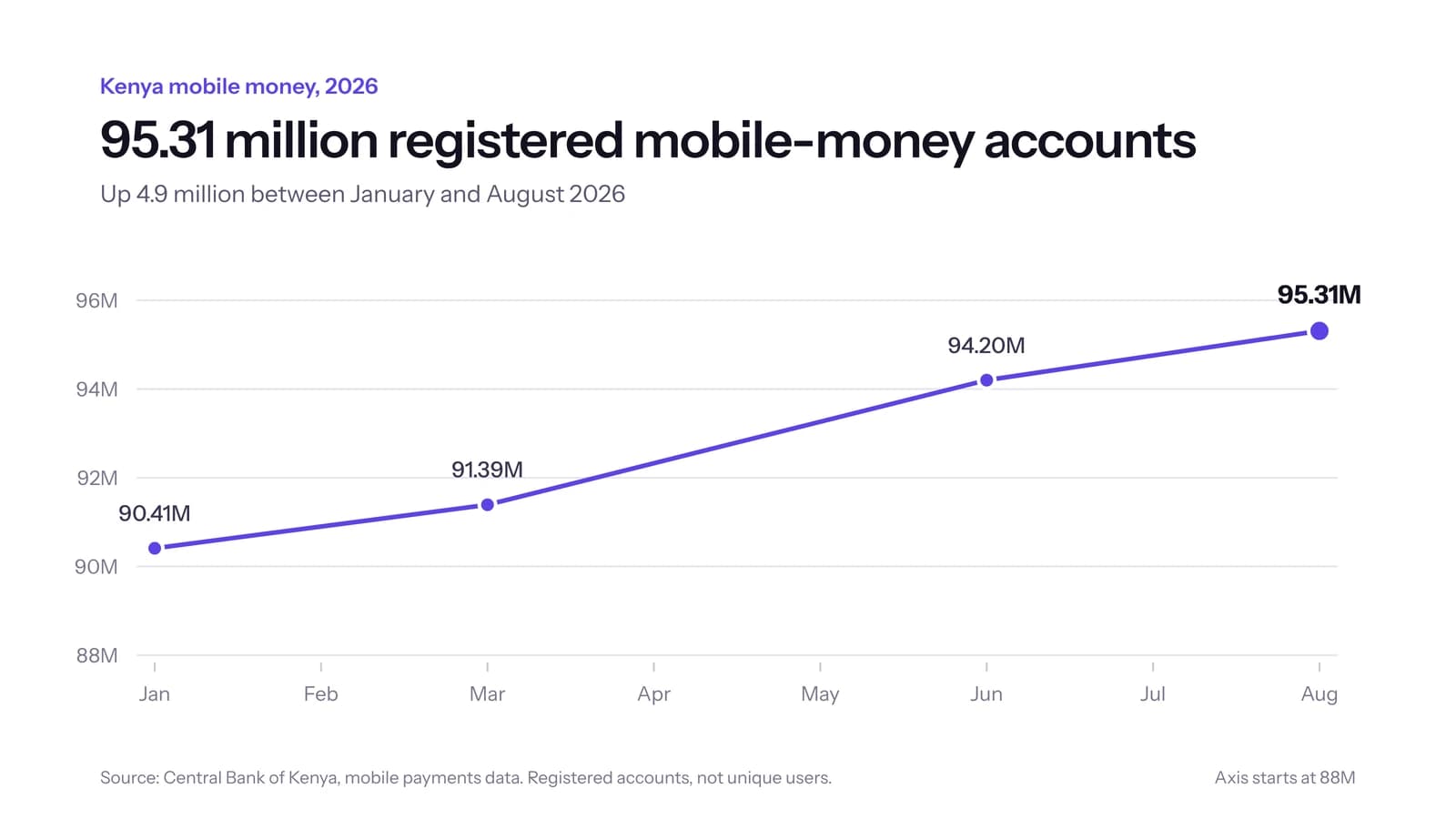
The Central Bank of Kenya (CBK) publishes its own monthly mobile money figures, and its count looks very different: 95.31 million registered mobile money accounts in August 2026.
The two numbers measure different things. The CA counts subscriptions on mobile networks. The CBK counts registered accounts, which can include accounts that were opened and are now rarely used. Neither figure is wrong; they answer different questions. When you see “95 million” in one headline and “54 million” in another, check which measure is being quoted before comparing them.
What it means for a business: large totals describe the market, not your customers. The number that matters for you is how many of your own customers pay by mobile money, and through which channels.
3. “34,000 agents left the market” is a three-month story
The CA reports 568,463 registered mobile money agents at the end of June 2026, down from 602,470 at the end of March. That is 34,007 fewer agents, a 5.6% fall in one quarter, and it has been reported widely as agents leaving the business.
Looking at a full year gives a different picture. The CBK’s monthly series counts active agents: 572,104 in June 2026, against 433,615 in June 2025, roughly a third more. The CBK series also shows an unusual peak of 621,389 in March 2026, so part of the quarterly fall is the count coming down from that peak. Neither report explains the change. Some commentators suggest that more people are paying shops and bills directly from their phones and withdrawing cash less often. That is a reasonable possibility, but the reports themselves do not say so.
What it means for a business: agent numbers are mostly about access to cash. If your customers rely on agents to top up before paying you, changes in agent coverage in their area can affect when they are able to pay.
4. Cash has not gone away
In August 2026 alone, Kenyans made 227.41 million cash deposits and withdrawals at mobile money agents, worth KSh 761.13 billion, according to the CBK. A year earlier, in August 2025, the figures were 221.13 million transactions worth KSh 688.44 billion. The value grew by about 10.6% while the number of transactions grew by about 2.8%, so the average deposit or withdrawal rose from roughly KSh 3,110 to roughly KSh 3,350.
Cash in and cash out is not the same thing as paying a business. It is people turning cash into mobile money, or mobile money into cash. But it shows how much of the economy still moves between the two every month.
What it means for a business: for many customers, paying you is a two-step process: get money into the wallet, then send it. When a payment is late, it is often because the money is not in the wallet yet, not because the customer is unwilling. A follow-up that comes back later, at a time the business chooses, does more than repeated prompts on the same day.
5. Most of it runs through one network, but not all of it
The CA reports that Safaricom held 88.8% of the mobile money transfer market at the end of June 2026. The remaining 11.2% is shared among the other licensed providers.
A market where one provider carries nearly nine in every ten transfers can make a business assume that one payment channel covers everyone. But a market share is a share of transfers, and with 54 million subscriptions in use, the 11.2% handled by other networks still represents a lot of customers.
What it means for a business: if your collection process only works for one wallet, some customers have to change how they pay before they can pay you, and a few will simply pay late.
What these numbers mean for businesses that collect every month
Schools, landlords and property managers, gyms and clubs, internet providers, professional firms on retainers and membership organisations all depend on customers paying the same amount on a schedule. For them, the latest figures point in one direction:
- Customers can already pay by phone, at scale, and the number who can keeps growing.
- The same customer may pay from different numbers, wallets or channels from one month to the next.
- Many customers still move cash into their wallet before paying, so the timing of requests and reminders matters.
- Matching each payment to the right customer and the right month, and following up only with people who have not paid, is where the time goes.
None of that is solved by more people having mobile money. It is solved by how the business runs its collection routine.
Where Roamerwave fits
Roamerwave is being built for that routine. It works on top of existing payment providers: it sends each payment request on time, follows up after the due date on the schedule the business sets, matches each payment to the right customer and account from any wallet, applies the business's own rules consistently and restores access the moment a payment lands, and sends anything unclear to a person instead of guessing. The aim is simple: the business knows who has paid, every month, without the manual work.
If your business collects from customers every month, join the waitlist and tell us how you handle it today at roamerwave.com.
How we read these numbers
- Communications Authority of Kenya, Sector Statistics Report, Q4 FY 2025/2026 (1 April to 30 June 2026): mobile money subscriptions, penetration, registered agents and market share.
- Central Bank of Kenya, Mobile Payments statistics (monthly, re-checked 19 October 2026; August 2026 is the latest month published): registered accounts, active agents and agent cash-in/cash-out.
- Percentages and averages not stated in the reports (year-on-year change in agents, cash-in/cash-out growth and average transaction size) are our own calculations from the published figures.
- The two sources use different measures (subscriptions, registered accounts, registered agents, active agents). We note which one we use each time and do not combine them.