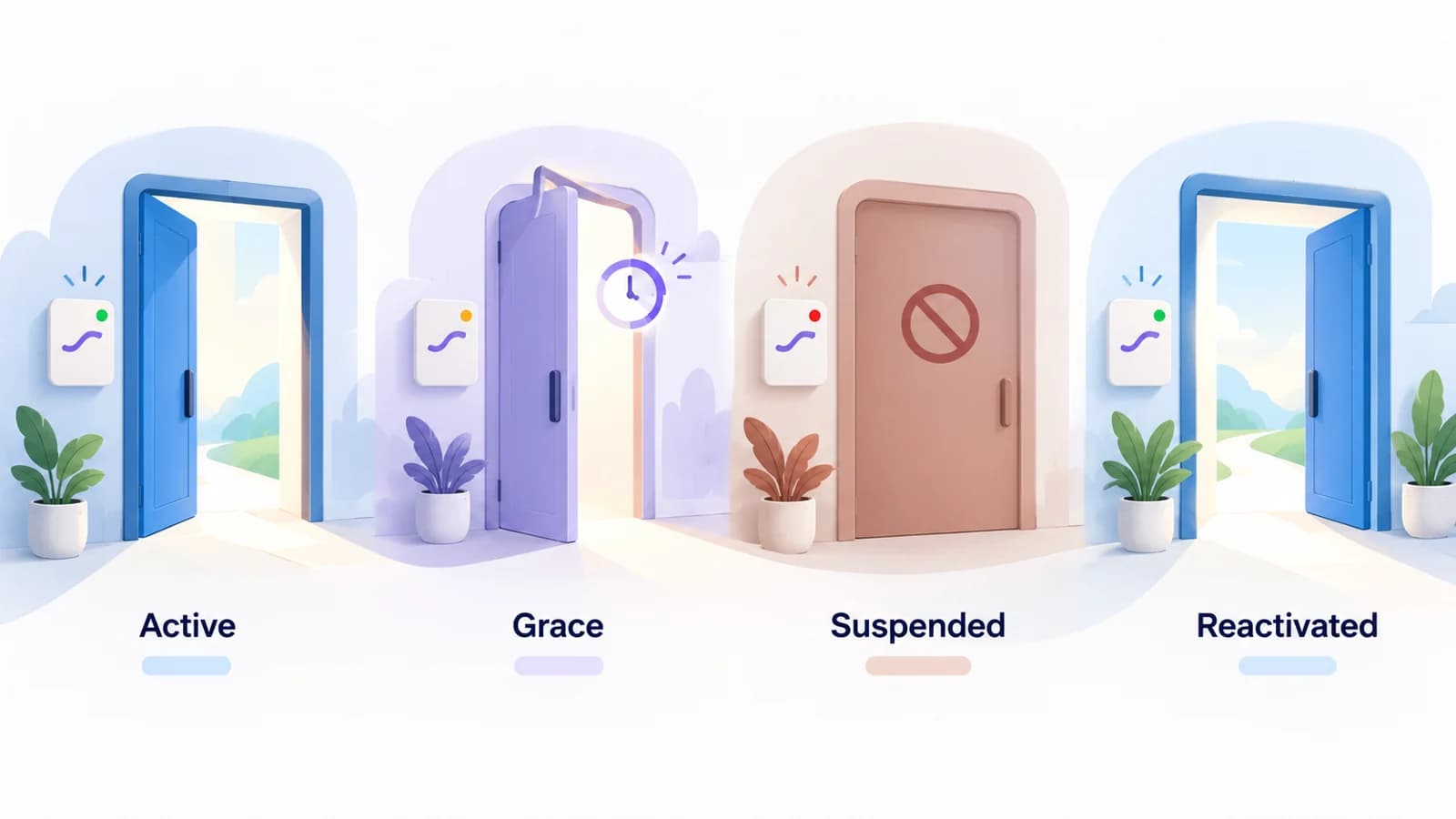
Payment state should inform service decisions, but it should not make them.
The merchant decides the commercial policy: how long grace lasts, what gets restricted, when human review is required and how quickly service returns after payment.
Gym membership
A gym may allow access through the paid-through date, add a short grace period, then pause entry until renewal.
A payment that is merely Unknown should not be treated as confirmed non-payment. Front-desk staff should see a review state rather than a hard suspension.
Reactivation can happen as soon as payment is confirmed, without waiting for finance settlement.
SaaS subscription
A SaaS product may move through Active → Grace → Limited → Suspended.
The exact sequence depends on the product. Read-only access can be less disruptive than immediate lockout for tools that hold customer data.
When payment succeeds, entitlement restoration should be idempotent and safe to replay.
Home ISP
An ISP may have a strict prepaid model where connectivity ends when the paid period expires, or a postpaid/grace model with automatic suspension after a defined window.
Reconnection should be driven by verified payment state and the network provisioning system, not by a staff member manually reading a payment message.
School or education installment
Schools often need more human judgment. A missed installment should not automatically trigger a digital access block unless that consequence is part of an approved school policy.
The billing system can flag overdue balances and payment plans while staff handle exceptions such as agreed extensions or sibling-account adjustments.
Healthcare or care plan
Care plans require particular caution because payment policy can affect access to sensitive or essential services.
Use explicit merchant policy and human escalation rather than a generic automatic suspension rule.
Keep four states separate
- Payment attempt state: what happened to the latest transaction.
- Invoice state: whether the commercial amount remains due.
- Entitlement/service state: what the customer can currently access.
- Reconciliation state: what finance still needs to finish.
A provider callback should update payment evidence. It should not directly encode every merchant's suspension policy.
A good reactivation rule
Define exactly what evidence restores service, how quickly the action should run, and what happens if the restoration job is delivered twice.
That keeps the customer experience predictable and makes support easier.
Write the policy as a state transition, not a vague rule
For each product, document the exact trigger, the resulting service state and the evidence needed to restore service. For example: invoice overdue by three days and no unresolved payment → move account from Grace to Limited. Verified payment → restore Active.
This makes the policy testable and prevents support staff from applying different consequences to similar customers.