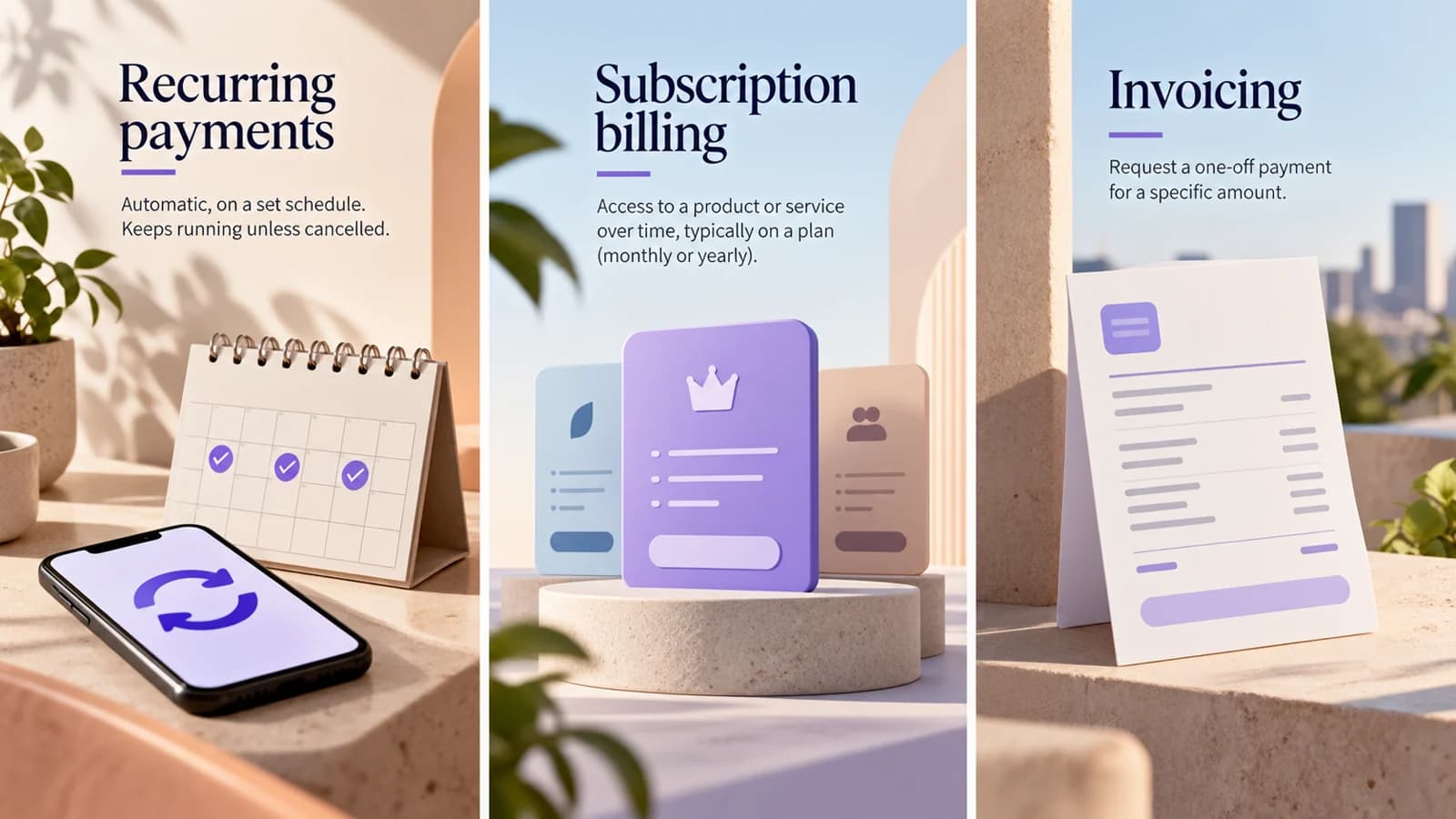
Recurring payment
A payment that happens in response to a repeated commercial obligation. The payment itself may be customer-authorized each time or may use a mandate-based rail.
Subscription billing
The broader system that manages plans, billing periods, renewals, invoices, trials, proration and account consequences.
Invoicing
The creation and management of a document or record that says what a customer owes for a particular sale or billing period.
Why the terms get confused
A subscription creates recurring invoices, and those invoices need payments. But each layer can exist without the others.
A school can issue recurring invoices without being a subscription business. A SaaS company can run subscription billing while supporting several payment methods. A payment gateway can process a recurring invoice without owning the subscription.
A useful mental model
Subscription or recurring rule → invoice → payment attempt → payment result → reconciliation.
A recurring obligation can exist without a subscription
Rent, school installments and annual association dues repeat, but they do not necessarily use a subscription plan with trials, upgrades or self-service cancellation. They still benefit from a clear due record and payment history.
A subscription can use several payment methods
The subscription determines what renews. The customer may satisfy the resulting invoice by card, mobile money, bank debit or another approved method. Changing the payment method should not create a second subscription.
An invoice can be one-off
A consulting project can produce a single invoice with no recurring rule at all. Invoicing therefore describes the amount due, not whether the relationship repeats.
Why the vocabulary matters in software
- Subscription state answers whether the commercial relationship is active, paused or cancelled.
- Invoice state answers whether a particular amount is due or paid.
- Payment-attempt state answers what happened on one payment route.
Keeping those concepts separate prevents a failed transaction from accidentally cancelling a subscription or creating duplicate invoices.